


Cedric had always been an uneasy sleeper. Even as a child, he’d never been able to fall asleep in cars, or in chairs, and only very rarely when the Sun was arched high in the blue sky above. He had long been accustomed to waking into a sort of semi-consciousness when his body began to stiffen and ache in the darkness, and when that happened, he rolled over to the other side and tried to go back to sleep. Sometimes this happened several times in a night, even when he had been young, and he had never thought too much of it because he could not know a different way of life.
What he was not accustomed to, however, was waking in the very early morning and feeling very much like he could not, or would not, sleep until sunrise.
And though it was Christmas; Christmas Eve, to be exact, somehow or other, he woke just the same.
When Cedric rose from bed, the first thing he did was slip his bare feet into a pair of slippers. He had dry feet, and they rarely smelled sour, but sometimes they were liable to get cold on the floors that were naked between the rugs.
Both his bedroom and the bathroom had a radiator, but the one in the bathroom was louder. Sometimes when he went in there, it was banging and hissing, and it had taken him a while to realize that the noise was perfectly expected for such a device. The sudden violence from the heater was enough to make him leap from his skin when he wasn’t expecting it, but he’d quickly realized no one else in the house thought a thing of it, so he feigned nonchalance.
It was clanging when he entered the bathroom in the dead of night on the morning of Christmas Eve. He relieved himself, washed his hands, and looked into the mirror.
His first thought was that he needed to shave, and his second thought was that his hair was too long and the ends were making the tops of his ears itchy, and his third thought was that even if he did not do so at this very moment, he needed to clean himself up and make a pass at appearing presentable because he was expected for dinner at Davian’s house in Manhattan.
His fourth thought, and it made him cold to linger upon it, was what Eloise had said yesterday when he’d extended the invitation to her. Cedric hadn’t wanted to go alone, and he’d had a pleasant picture in his mind when he imagined getting a chance to talk to Eloise outside the walls of the Magicademy.
If he tried hard enough, he thought, maybe he could conjure a joke that was funny enough to make her smile.
But instead, when he’d mentioned the Mage’s event, she had made a sort of grimace and scrunched up her nose, though she might have been trying to hide her true feelings. She had been polite, as he saw she always was, and she’d paused and said, ‘no thank you, I’d rather not,’ and while her lips were thin and still pressed into a frown, she had added, “I… don’t really like Davian.”
And when Cedric stepped out of the bathroom door cold, he felt many things but none of them bold. And he thought and he thought and he found his cheeks hotter, so he went back for water without any Who daughter.

All of the children in the house, with Suyon as the only exception, slept on the third floor. There were four bedrooms there, and with the sole addition of the bathroom and a dusty bookshelf at the end of the hall, the floor had little entertainment to offer except a quiet place to breathe.
So when Cedric did not want to remain in his room, he had to enter the hallway and prepare to descend the staircase.
Even in the night when the beds were heavy and still, the house groaned and moved and spoke to itself. The clattering radiators were the most difficult to ignore, but they were not the only ghost in the walls. The floorboards shifted with the weight within and the windows creaked when the wind pushed them in their frames. Every hour, the towering clocks, one on each floor, announced the passage of time. And in the minutes between, when Cedric passed by the grandfathers, there was a pendulum of brass that was moving from left to right and back again and prodding forward with a patient clonk, clonk, clonk from the mechanisms inside.
So when he passed by the clock in dark wood and gold inlay on the third floor, that was the first thing he noticed.
It was stopped.
Cedric didn’t know a damn thing about these sort of clocks but he imagined they needed to be re-wound every so often, and they kept on tick tick ticking because of the energy stored on springs or on suspended weights behind the glass.
And when he saw the clock, the instinct he had was that it had been forgotten. It had been forgotten because its function was quiet and assumed and taken for granted until it could not anymore perform its essential task.
It had stopped, and he looked at the time and read 3:17, which immediately made him think of a day in March, but he knew it was wrong and he shooed it away.
And he realized it was not entirely 3:17 at all because the hand had not quite reached the marking for that minute and had instead run out of energy just short of the line. And he couldn’t get a thing intelligible from it regarding the current time. Had it stopped earlier this morning, or had it been dead yesterday? Could he have gone this long without realizing the halted timekeeper?
Cedric left the clock with his questions lingering. And he tried to find solace in the fact that none of it truly mattered; the orphans woke when they woke regardless of what the clock read.
The stairs were carpeted in deep red with a sort of yellow-gold trimming the edges. Like so much of the ornamentation of the home, it had initially struck him as needlessly ornate, even baroque in its attention to detail. And yet, as the weeks wore on, critique had become consideration, and nothing in the house felt accidental, and even the turned wood of the columns at the side of the staircase felt somehow deserved.
On the second floor of the house, Cedric found the inset in the wall where the candelabra idled while off-duty. Still afraid to probe the rules of his broken universe, he had pocketed the box of matches and brought it with him. He took a single match from the stores and struck it, and it fizzled brilliantly as he brought it toward the wick of the single black-grey candle. The wick had been left carbonized from its last use, and it resisted ignition, but only for a moment before it erupted in flame and cast diffuse light into the hallway.
He had fully intended to step into the library and read in silence for however long it was he had left until sunrise; he even imagined avoiding starting the fireplace in order to minimize announcing his presence, even if it meant sacrificing the boon of ambient heat. It had become a quiet habit this month, and he welcomed the solitude, a blessing he was not often afforded in a house where lived seven others.
But he was not to have that today.
When Cedric stepped into the library, the light from his candle fell upon a canvas suspended on a dark easel. The height of it was such that the top of the canvas was no higher than his own crown, and the bottom, mostly bare, was far below his waist. So when he looked at it, the only part that had been painted atop the sketch beneath hit him on the level, and looked right into him.
Looked — because they were eyes.
Little else had been painted, but the eyes that had been given color had been done so in unrivaled detail. They were eyes, dark, like pools of shadow that opened onto a soul he could not touch, and he knew those eyes because they belonged to the eldest of the Matron’s charges.
Someone had seen Eloise, and someone had brought her eyes into the paint.
Cedric did not know how long he stood there, because when he saw her on the canvas, his body was frozen and he just stood there stupidly. He couldn’t find words to form questions, so he just kept looking, and by the time he realized he’d brought his left hand up to his face, he might have been there for a minute or more before the sudden appearance of the orphan Matron brought him back into the present.
She did not walk past him, rather, she simply appeared when Cedric involuntarily blinked, and she moved with haste he had never before seen from the old woman.
Myrtle raised her hand and tore the canvas from its support, brought up her knee, and broke the canvas in half over her thigh. And when she did that, his contact with the eyes was severed and the fabric was ripped and he knew the paint must have been fresh because the smell of oil went into the air.
Cedric was afraid then. Where he had been staring at the eyes that he thought he knew, he realized that he didn’t know them any better than he knew the old woman, the old woman he had never seen destroy or break or cut anything but a loaf of bread.
And when she left, disappearing as instantly as she had appeared, she took the portrait with her. And even though she was gone, the image of her lingered in his memory. She had looked at him through the side of her face, and the look was black: black like the dress around her neck, black like the coat and gloves she wore when she was outside, and black like her hair had been in that photograph taken all those years ago.

Cedric went back to his room and he thought about showering but decided against it because he still didn’t know the time and he didn’t want to risk seeing anyone on his way out of the house.
He put his clothes on in a hurry, clothes he had never worn before so they were deeply creased. He had a blue shirt, a tie that was a deeper blue still, and khakis that were somewhat paler than he might have preferred. He opened the drawer to his bedside table and took several subway tokens but left the box of matches. He took his wallet, what little use it was, and slipped it into a back pocket that was too small to hold it comfortably. And when he was done mulling over what he could not plan for, he left the house.
The tired Sun rose late at this time of the year, but it always invariably would wake, and likewise it had begun to send streaks of purple and gold across the heavens.
It was majestic, and Cedric noticed it, but kept his eyes drawn downward as he made his way through the streets of Astoria.
It was early yet, and he might have liked some breakfast, but he’d run from the house without so much as pausing to steal a croissant. And he thought it might have been nice to get an egg sandwich once someone opened up, but he didn’t have money for a haircut he desperately needed, let alone change to waste on food he could get for free somewhere else.
At Ditmars, Cedric ascended the stairs and entered the station. He dropped a token into the turnstile and sat inside a train that was waiting. He knew once it started moving, no one would pay him any mind and he could keep going until it was time to get off.
Finally, surrounded by strangers, he was alone.

[ “always crying” ]
He was running, and he was crying. He was in pain, but from what, he could not tell.
[ “quit your bawling” ]
He hadn’t heard that voice in a long time, but when he heard it again, it was a knife with an edge that could split to the bone.
[ “weeping, wailing, carrying on” ]
He was young when he heard it, and he kept running in the dark because he could not find her.
[ “what are you, a sissy” ]
She had said these things to him, and he had tried to hold back his tears because he knew that she was right. And now he was looking for her because he hurt and he was in pain and she was all that he had.
[ “Mom?” ]
That one was his, the question he couldn’t forget. His voice was small, but familiar because it was the one he’d had first.
[ “Mom? Where are you mom” ]
He kept going, and he thought her voice was getting closer.
[ “he always makes so much damn noise” ]
That was when he saw it: the Chair.
The chair that was hers, the one that reclined with the lever on the right side, the one that was plush and a sort of brown-green that couldn’t be named, the one he was never to sit in because it was not for him.
It was faced away from him because he’d walked in through the door. And though it swiveled on its base, it was faced away from him because that was always how it was when he walked into that room.
He reached his hand toward the corner.
[ “you wanna cry, kid?” ]
The sound was not hers, but it wasn’t his either.
[ “i’ll give you something to cry about” ]
His hand was still reaching, so he let it continue. He touched the chair on the far left, and when he pulled, he could move it, and it was something he had never done and his heart fell a little because he did not—
Her legs were sticking out straight because they were short and could not fold over the edge. The hair was a crown of brambles and her eyes were that color, that color that burned because it was unlike the others.
Because they were red.
[ “So, Junior, what’re you going to do?” ]
It was her, it was Friday, and she looked at him with the eyebrows that fell down over her eyes because she was looking right at him.
[ “Are you going to hit me go ahead hit me” ]
And she was looking at him and it hurt to look back.
[ “Go ahead Junior hit me I dare you” ]
He just kept looking and maybe he clenched his teeth but then he wasn’t really sure where he was at all and didn’t know if he had any.
[ “I double-dog dare you hit me just hit me” ]
He was tense then, because he wasn’t moving and was trying to do something else.
[ “Junior?” ]
And because she was sitting and she was eleven or twelve or thirteen or whatever, when he brought his fist up and swung, it was at—

“Hey, kid?”
Cedric’s eyes flew open and he was in a subway car and someone had touched him on the shoulder.
“Kid, you okay?”
Cedric blinked a few times because the light was bright and he realized that he must have been asleep and he felt ashamed and confused.
“I—” he tried to say, the nightmarish afterimage still pressed over what was in front of him.
The man had a kindly face; he was balding, but with a generous moustache, and his face was wrinkled in places.
“Just don’t miss your stop, eh?” he said before standing. “You get some rest tonight. Sounds like you need it.”
He took his newspaper from the seat next to him, folded it once more, and left the train at the next station.

“Compliments of the season!”
Cedric presented himself at Davian’s flat when abject hunger would let him wait no longer. Sometime around midday, he’d realized his stomach had passed beyond the threshold of mere complaint, and he’d felt light-headed when he’d moved around and when the light from the subway car pressed into his eyeballs.
“So good to see you, lad; it’s not yet three—” Davian began, but he was anything but disappointed. “Have you had lunch?”
Cedric had been inside the train system for hours, and at some point, it had become tiresome. And, ad nauseam, he’d recalled that Eloise hadn’t wanted to come, and he’d lamented that reality for hours.
“Sorry I’m so early,” Cedric said, lingering awkwardly on the stoop. “I didn’t want to be late, and I didn’t know how the trains would be running because of the—”
“It’s no matter,” Davian said. “Come in, come in.”
Cedric stepped into Davian’s home and it was quiet; the kind of quiet that meant no one else had arrived first.
“May I take your coat?”
Cedric removed his jacket and gave it to the Mage, who draped it over the staircase railing. He looked toward the sitting room, thick with the smell of evergreen, but did not enter. In the room had been erected a generous pine, and it nearly touched the ceiling, excepting of course an angel who stood atop the highest bough.
“I do hope your commute was not too much trouble.”
Though the tree was decorated with ornaments and bulbs, there were no gifts laid on the skirt around the tree. Cedric turned back to see Davian. His mind was unsteady, and his thoughts momentarily wandered toward the Matron and her sidelong glance, but he tried to steer it back toward the present.
“I—” Cedric said, unsure whether it was appropriate to render his full honesty. “I took the scenic route.”
Davian laughed.
“It is good to be well-traveled,” he said, and his face was cheerful, because he could not hold back the next question.
“Can I offer you a drink?”

When Davian poured plain boiling water into a white mug, Cedric just sat there because he figured the Mage knew what he was doing. And when he let the hot water sit there for a minute or two and then dumped it into the sink, he again remained placid because he knew he didn’t know any better.
Davian, for his part, was watching Cedric while he struggled to bite through an almond biscotti.
“…I assume you’ve never had a hot toddy?” the man asked, and Cedric was disoriented, a little slow to the uptake.
“No,” he said, trying to empty his mouth of the biscuit. “Never.”
“It’s a lovely drink,” Davian said. “Good to keep you warm on a winter’s night.”
“The English have their own interpretations, but the first time I knew it, it was in a warm country very far from this one,” he said, adding dreamily, “How I didn’t know how things were to turn out.” Davian was lost in his imagination, and Cedric knew better than to do much more than acknowledge receipt, so he kept chewing.
“Lemon, clove, honey,” he listed, and as soon as Cedric heard the words, the items were there before them. The honey and clove were in their own wide-mouth glass bowls, and the lemon was whole and reflecting white from the light above where it was not a perfect shade of yellow.
Cedric had a vague fondness for lemons from his years working in the groceries, thinking them sometimes too beautiful to eat, an inclination that required little effort to uphold because he didn’t have a single experience using them in the kitchen. Lemons, like most fruit, were non-essential foodstuff.
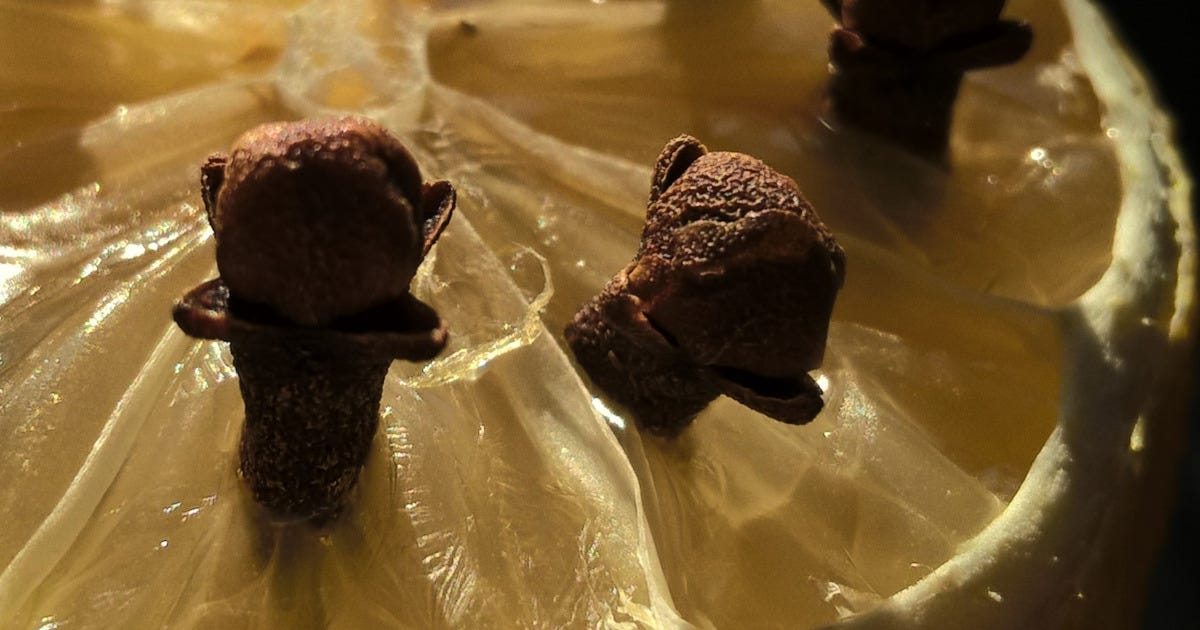
Davian, having put the second pot to boil, was looking down at his summoned components. He put his fingertips into the bowl of cloves, chose the first, and then began to ceremoniously stud the lemon one-by-one with the dried flowers.
And this he seemed to enjoy immensely, and he was content to press each spike into the citrus, and when the skin yielded to the pressure, the juice of the fruit was atomized and soon the air smelled bright and clean.
The kettle began to whistle then, so he stopped and removed it from the heat.
He poured amber whiskey into the mug, and then the boiling water hit the wedge of lemon that had been cut and the smell of fruit and spice went even more boldly into the air. And when Davian lifted the cup and gave it to Cedric, it was warm and the liquid was steaming, and he raised it to his lips but he knew to wait until it was drinkable because otherwise he was going to burn his tongue. So he looked past the mug and the drink that was still too hot and he saw the lemon that had a piece removed, only a sixth or so, and the inside was pale where the pulp was exposed.
He blew on the drink as Davian watched, and he noticed how the light reflected off his dark brown eyes and his skin was smooth as it had been on many Christmases before he’d been born.

“Thanks for lunch,” Cedric said, wiping the corners of his mouth with a green napkin. He took a drink of water; water he’d asked for when the toddy had left him feeling uneasy.
“Sorry I couldn’t finish everything.”
Water, more than booze or cookies or chicken, was what he had wanted most of all.
“I’m quite sorry to hear you skipped lunch,” Davian said. “Is Myrtle failing to feed you?”
“No, I—” Cedric said anxiously. “I left before lunch.”
Davian just looked at him.
“I left before breakfast,” Cedric amended, feeling that gaze upon him.
“I didn’t sleep well and when I woke up,” he said, “I—”
He didn’t know what he wanted to say next because he didn’t know where he was going, and he wanted to avoid revisiting what he had felt this morning.
“I just wanted to get out of the house.”
Davian’s face softened and laugh lines erupted unbidden at either side of those eyes. “Yes, well, amidst the innumerable progeny she’s collected, I daresay I don’t blame you.”
“The kids are alright,” Cedric said, though he wasn’t sure he believed it. “It’s not them, it’s me.”
He let his eyes go stray because he was afraid to tell the truth. “I have had a lot of trouble sleeping,” he said. “I’ve been having bad dreams.”
Davian looked at Cedric curiously, and his face was still, quite different from how it usually was, except he raised one eyebrow and searched the boy.
“Bad dreams, eh?” he asked, and then his expression collapsed into its usual confidence, marked with an amused smirk.
“I have a fix for bad dreams; have you on your feet again, right as rain.”
Davian took his left hand and put his finger on his skull to point toward the mind within, as if he were indexing what it held. Cedric found the gesture uncharacteristic, so he squinted his eyes and he thought he blinked too long because the lights seemed to flicker but he knew he had felt that before.
The Mage lowered his hand. “Another time though. It’s Christmas.”
And as he said it, it was heavy, and Cedric was not sure what to make of it.
“Speaking of Christmas!”
Whatever cloud had surrounded the Mage, it evaporated.
“I have a small gift for you.”
Davian left then, and for a brief moment, Cedric was alone. It was strange to be in the room by himself, and he looked at his plate, where he’d left half of what had been offered to him. He took the napkin and folded it, as it had been presented to him, and placed the fork again on top, and soon the Mage reappeared, and in his hand was a small box, squarish, and Davian gave it to him expectantly.
“A token of my affection.”
Cedric took and slowly opened the box.
For a moment, he didn’t say anything. There were two pieces of jewelry laid on an off-white cushion, and they were absolutely encrusted — with diamonds. He didn’t have a clue how he was supposed to wear such a thing.
Cedric looked up at Davian with an apologetic crease between his brows.
“I’m sorry,” he said, and spoke with slow remorse. “I don’t have… pierced ears.”
Davian’s head whipped backward, eyes closed and mouth open in pure joy. He was — laughing. It took him several long seconds to come back to normal, and he put his hand on Cedric’s shoulder.
“Cedric my dear boy!” he said in one breath. “You truly light up my life.”
Cedric’s cheeks were turning scarlet and he was trying to resist frowning so he just looked at the box.
“They’re cufflinks,” Davian cheerfully declared. “You wear them in a shirt that deserves them. And don’t worry yourself at all over the cost; I didn’t pay a penny.”
Guilt pulled him to look down and attempt to render gratitude. Little nubs of silver held each piece in place, and not a single setting lay bare. There were a hundred edges to the inlaid gemstones, and where the surface was clear and flat, the split light showed tiny rainbows dancing and reflecting back on the recipient. Cedric was uncomfortable and returned his attention to the man.
Davian’s eyes were still full of delight as he looked at his charge, but the corners of his mouth fell just enough for Cedric to see something else. And he kept looking.
“They were my father’s.”
Cedric was sure he looked the fool.
“…Thank you…” he said, remembering what he was supposed to do, and he looked again at his half-eaten meal and put the box next to the dinner plate.
He wasn’t even looking at Davian when he offered, “Are you sure you’d not like something else to eat? I don’t want to be a poor host.”
“I… I’m not really very hungry,” Cedric said, and slowly, he took the lid of the box in his hands because he wanted to cover up the scintillating stones.
“Perhaps a little fresh air will settle your stomach,” Davian said, adding genially, “Let’s go for a drive.”
Cedric left the lid where it was and looked at the Mage.
“I have just the excursion in mind. Myrtle has an old house out east she never uses. Sits there and collects dust while the mice scavenge for crumbs. I’ve tried to convince her to spend more time there, have a nice holiday; but alas. Women and their ways.”
Cedric did not say anything.
“Come, let’s take the Wraith,” Davian said. “You can drive.”
He was unsure, and his instinct told him to retreat.
“I’m a little tired, I don’t know if—” he said quietly, but Davian would not have it.
“And I’m a little worse than that,” he announced. “Cup of coffee and you’ll be on your way.”
He added, as an almost muttered aside, “I could use one as well…” and he put his right hand into his pocket and withdrew a set of keys, which he quickly tossed underhand to Cedric.
Cedric, bewildering even himself, caught them.
He looked down at the keys, bright and silvered without a speck of stray dust in the corners.
“But…” he protested, raising his face. “What about—”
He thought he was being polite. He thought he was being considerate and kind and respectful to remind the Mage of something he might have forgotten between the fine wine and hors d’oeuvres. Cedric had imagined tens of recipients of invitations not too unlike the one he’d read last week: Mages, Mortals, and who-knew-what. And he thought they’d all be disappointed to knock on the door that evening and find an empty house, but then he saw Davian and the reality hit him like a wall of bricks.
“Yes?”
Cedric was at a table for two.
“Uh,” he said, swallowing the spit pooling in his mouth. “N-nothing.”
Davian lowered his head just slightly to look at Cedric. “Right then,” he replied. “Let’s get going.”

Cedric hadn’t driven a car in months, and he’d never driven anything like Davian’s Wraith.
The purple car was enormous, and the feature that seemed the most exaggerated was the nose in front of the driver. The roof of the cabin extended over his line of sight, so the windshield was far in front of him. The car sputtered and chattered from time to time and the steering wheel was large and thin.
Cedric assumed the car was mostly accurate to however it had been made, save the coat of flashy paint, but then, it was an automatic.
And still some further details couldn’t have possibly been stock, namely the addition of a holographic arrow that floated semi-transparent above the dash, quite obviously the handiwork of a man who had no desire to pull over to the side of the road to unfold a map.
“So how’s life with the old broad treating you?” Davian asked. He was seated in the passenger seat, and he’d set the seat so that he was leaning back at a slight angle, and with a golden flask in one hand, he looked very much to be enjoying a moment of leisure.
Cedric was carefully watching the traffic on the Long Island Expressway.
“It’s going fine,” he said, and he thought about the campfire in the backyard and the marshmallow, but decided instead to remain nonspecific. “The kids have taught me some things.”
But his attempt at humility felt dishonest, so he added, “I’m making progress.”
“Glad to hear it,” Davian said. “There’s little to gain from sitting and waiting for enlightenment to come to you; rather, you must reach forward and seize it before it slips from your grasp, lest the opportunity leave you forever.”
“Life is too short for that kind of sloth,” Davian delivered while Cedric sat at the wheel, noticing how strange it was to feel his hands forced so far apart, and though his right hand felt bored and idle, he could not yet justify letting it go slack.
He thought he ought to say something, but Davian was the first to break the silence.
“She doesn’t push the children enough; in part because she has taken in too many, and in part because she has the wrong approach.”
“She’s become soft in her old age,” he said. “She wasn’t like that when I met her.”
Cedric kept driving because that arrow was still pointed ahead.
“The year was 1940, and I remember it clearly. She’d come to do war against the Germans, like so many Americans who fancied themselves our saviors,” Davian recounted. “And she presented herself as Myrtle Soo and though her face had already begun to show her age, she wore no wedding ring and never said a word about where her heart lay.”
“Though she was cagey and private, I took to her immediately, finding her charming and capable, intelligent and cunning; a woman who knew better than to reveal the cards she’d been dealt when there were yet more hands to play. And still she danced around questions about where she had come from and who she’d left behind; always answering supposition with supposition.”
“She worked in potions and poultices, claimed they were more palatable to the soldiers, scared them less, left them less likely to condemn our feats as works of the Devil below.”
“And many refused her anyway, and some died to things they didn’t have to die to. Quibbling over the interpretation of the source material is good fun when you’re well, but barring that, I’ll save your life first and we can later discuss the barriers between your soul and salvation.”
“Either way,” Davian continued, “it may be a bitter pill to swallow.” And when he gave his claim, Cedric could hear the liquid in the flask slosh around because Davian took another swig.
Cedric was not really enjoying the conversation, but he supposed it was better than the pain of awkward silence.
“She gave me the keys to the house in Riverhead years ago,” Davian said. “After all the years since I’d come here, I thought it meant something to come from her, but I soon realized it meant nothing of the sort because she doesn’t live in the same world as the rest of us.”
“We’ve no business taking as a talisman what is truly a trifle.”
“I believe she keeps a man to look after the place,” he said, changing direction. “But I’m sure he will be no trouble.”
Davian took a breathy pause, and then added, “He wouldn’t, because it’s Christmas.”
And Cedric kept quiet for a while because he didn’t have anything to add. Davian went quiet too, and Cedric thought he was just looking out the window or perhaps morose about his time on the battlefield long ago, but when he looked to his right, he found the Mage was asleep.
So Cedric looked back to the road and he kept following the little arrow that pointed far and away from the darkly-bricked house in Queens.
← previous || Table of Contents ||next →