


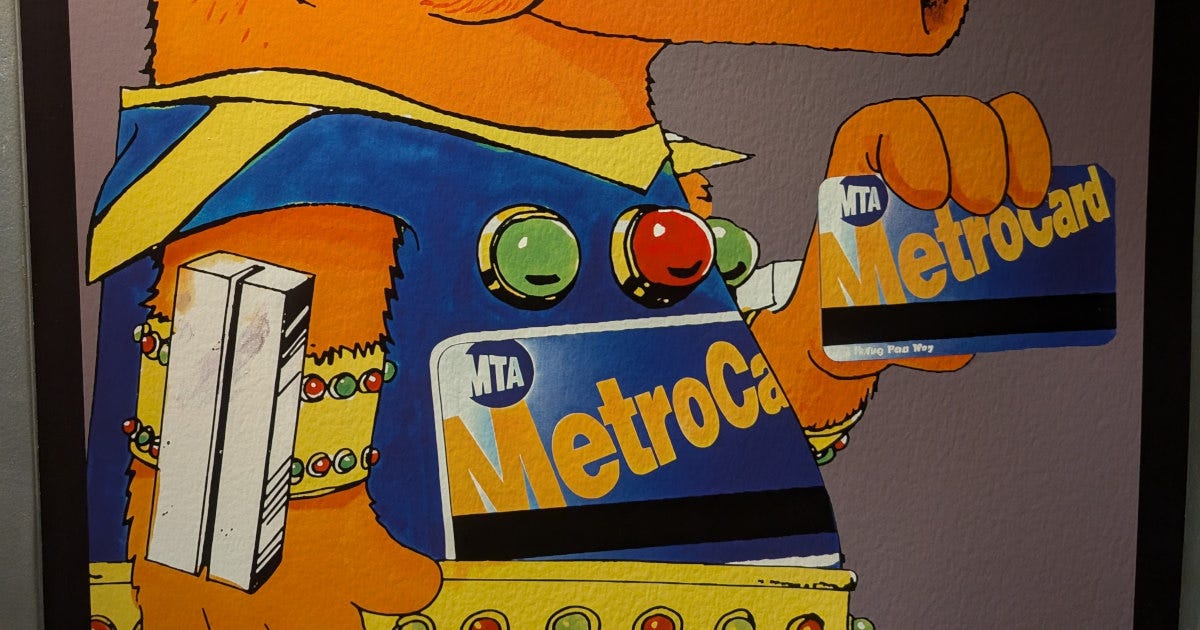
In front of a large cardboard cut-out, there stood a strange man. He was not old so much as he had become weathered. His skin was deeply wrinkled from a long life beneath the Yellow Sun, but still his long black hair shone in the light.
( “What does this say” ), he asked his companion.
They had descended the boat at South Ferry together, but anyone who was really looking would have known they’d been traveling together for far longer than that.
She smiled at him, because she loved him and his questions.
( “It says Caardvark” ), she said. ( “It’s a play with words — they put the word ‘card’ in front of ‘aardvark’ and mash them together — Card-vark — C-Aardvark” )
Then she added sweetly, ( “It’s supposed to be funny” )
The man with the old skin was confused, but he did not sneer. He looked at the cartoon and asked, ( “And the clothing — Is that supposed to be funny too” )
Daisy rolled her eyes in quiet delight. She took his hand in hers and tried to lead him away.
( “C’mon Ben — We could be here all day — but we really ought to get going” )

If anyone walking the streets of lower Manhattan had stopped the two to inspect them, odds were stacked against one who thought they could glean the truth from a second or third glance.
The woman had a smooth face and bright hazel eyes and hair that was cropped short so that it only curled around once or twice before it found its way to an end bleached by years roaming beneath the open sky. And though she was younger than him, none would have taken him as her father because a New Yorker would have said they looked nothing alike.
But maybe, sometimes, even an ordinary city-dweller who had no reason to think he knew anything at all might look into their eyes and think they had some ancestor in common. And maybe that city-dweller would be right.
Daisy had been roaming the land for a long time, but not nearly so long as her friend. And sometimes when she looked at him, she knew only part of him was able to look back at her. When his eyes were dark and his pupils were tight, she knew he was hearing the cries that the air had borne before the dying had become the dead. When she saw this, she would smile at him to try to bring him back to remembering the things that were still growing on the Earth.
Still other times, she knew the world was changing.
Many long years ago, when she had been small, life had not seemed so bad. The ones that owned the house into which she’d entered this world let her live in it, and they also had her read and write and work her figures. But after a while, she did not like the things they told her to read or the things they said she had to do to earn her keep. So she took to hiding in the woods and trying to get the smell of the kitchen out of her clothes. And when she got wet and tired and hungry, she came back because she had to. Because she’d been trying to find the place where the rabbits hid from the sound of gunshot, her dress would be covered in burrs and thistles so they removed it and covered her in scars instead. She did not learn what they were trying to teach.
One day, she ran into the woods again, and this time, Ben was there. And he looked at her and asked if the scars still hurt her when she touched them, and when she said not really because she didn’t usually touch them, she saw that he was crying, and he brought his fingers to his face and gave the tears to her. And where the crying dampened her skin, she felt the pain again, but she was not afraid anymore.
She went with him, and followed, with nothing in her hands but the letters that danced in her mind.

Daisy had never been on the Manhattan island before. Ben had, but it had been many long years, and sometimes he used a place-name that was more legend than language. The path of the Sun was familiar to him because every year it still made the same sort of an arc across the blue sky, but now there were tall structures of steel and glass that reached toward the clouds and the trees he had known had long been felled and he didn’t always know where he was. So he let his companion take the lead.
Headed north from where they had left the boat, the pair wandered through the city for a while. Daisy had seen many places where people gathered in great density, and each was alike in some ways while having their own ways and mannerisms. But people were what interested her most of all, and the sounds they made were their own kind of music. But the truth was that it did not take people long to figure out that there was something very peculiar about them, more than just the way their eyes shined, and when the people became afraid, they were quiet and frowned and did not sing anymore.
So when the people would not open their mouths and talk to her, she found the words they left behind and listened to what the shapes had to say because they were never silent unless she stopped looking.
Ben could read the way a leaf had been broken where a creature had strode past, and he knew how long a vine had been climbing by how it gripped a tree, but when it came to the symbols men had invented to give their voices life that lasted when the sound had long faded, he let his companion do the talking.
( “It says ‘Liberty’” ), she told Ben.
They were standing in front of a tall iron pole and looking up at an arrow that turned with the wind.
( “It says here” ), Daisy said, now reading an inscription that lay beneath, ( “That it is the fifth of its kind — the English tore it down once twice and yet again — and still the Sons put it —” )
( “It wasn’t iron then” ), Ben said cryptically, looking at the letters above.
( “Nineteen twenty one was when they put this one up” ), Daisy replied, still reading the paragraph at the ground. ( “So — seventy-three years —” )
( “It was seventy-four” ), he quickly corrected.
Daisy did not know why he said that, but she knew that the place was thick with spirit, and when they were in places where the living things had been made to bear what they should never have been made to bear, Ben heard what she could not. And then sometimes he was a Conduit, and she knew she did not understand, but she thought she might someday, so she listened and remembered and took it with her.
She had brought him here because she thought the cars and cement and chatter had made him tired, but she saw that he did not want to rest because he wanted to keep going.

( “Have you ever noticed how the wolf looks at his kin and can speak with his eyes while his mouth remains still” )
She was still young in her memory, but she was then, as always, a quick study.
( “I’ve never seen a wolf” ), she admitted. ( “We had dogs, and cows; pigs, and cats and —” )
( “The dogs can, but they look up more than they look out” ), he said.
( “What about the cats” ), she asked.
( “Some of them feel the wind in their fur when they chase the vole — others are too tired to hunt and sleep by a conjured fire, but even they retreat to Dream” )
( “The speech is in the twitch of a whisker — the turn of a tail” ), he told her. ( “You will learn it too” )
And he added, humbly, ( “And you will realize that you never learned anything from me because it was already in your heart” )
( “What if I want to get you something for your birthday” ), she asked. ( “And what if I don’t want you to know what it is” )
He smiled when he looked at her and said, ( “What could you get for me that I don’t already have” )

There were still things on the island that grew from soil and Sun. When the smog left ash in his nostrils, he tried to find what had not yet been burnt. In some corners there were bags of refuse, and still other things that had been discarded lay on the sidewalk in plain sight.
What the people didn’t want, he knew, would feed the skittering and crawling creatures that hid from the daylight. Where there was more than was needed, there would those arrive with open mouths and desperate hands.
Daisy had never been here before, so he let her find the way. She had a sense of what she was looking for, and though it had been many long years, he knew she would never make a wrong step.
She told him the place was called Washington Square Park, and that didn’t mean much to him, but he remembered the sound because what he would have said instead wouldn’t have meant anything to most anyone else.
The people were many, and they were doing all kinds of things that seemed familiar. The littlest ones were bouncing about like tiny deer, and the ones who were larger still had put machines below their feet so that they could move even faster. The biggest and oldest were burning things that made them remember what it was like to be young and forget what it was like to be old and altogether the place was, in that way, not very different from how it had been.
At one place in the park, there was a very old elm, and they waited for a while and watched it, and while they did that, there weren’t as many people around because they were occupied with other things.
( “This tree — it reminds me of someone” ), Daisy said, and she was smiling because she knew he knew who she was talking about.
Ben was lost in Memoria, and when he was lost in those paths, he often misread what she said to him, and his response was somewhat flat.
( “I don’t see the resemblance” )
( “It’s Grandfather” ), she said, and he felt immediately embarrassed to have her say that.
( “I did not know what I was saying when I said that” ), Ben admitted sheepishly. ( “I do not say that anymore and I wish you wouldn’t either” )
( “You only said that then because you were young and you knew the ones who had seen the rise and fall of many Suns were called Grandmother — And because you had never known a Man to live so long, you said that” )
He liked it when she repeated his stories back to him and tried to soothe him because sometimes it worked, and he was just silent to hear what she would say next.
( “I am sure the honor you intended was the one that was received” )

Sometimes it was hard for Ben to remember the things he’d learned long ago, but that wasn’t to say he ever forgot.
For a long time, before he knew Daisy, before he knew how to find what he needed in the Wild That Gives, the oldest and wisest of the mothers taught him how to make the Dreamcatcher.
And he could not anymore shape the exact story she had told or the pictures she had drawn or the pigments she had chosen, but what little he could understand of the old tongue was something he thought about often, because he wanted to carry on what they would have wanted him to carry on.
The Dreamcatcher was medicine, he knew. And medicine was like any tool — a knife could make a serving of food nourishing, and it could slit a throat.
And the medicine was valuable not because it delayed death, because there were many things that could do that. The Dreamcatcher was valuable because it captured the things that frightened men and made them believe that they were better off dead.
Once it had not been so difficult to find the things he needed to make the Dreamcatcher. Each one was different, and when one broke, he used the old to make the new. That was how he had been taught. When the threads became weak from holding the Dream, the ones that remained were carefully cut and woven with what was supple and young from the wild places.
But it was becoming more and more difficult to find the things that grew because they had been brought by birds instead of by men.
And he could not make another Dreamcatcher because they were a lineage, and, some twenty-four years ago, that lineage had been broken.
Ben knew the Sphere Who Gave The Light was one thing, and She Who Would Not Turn Her Face was another. But she reflected that light when she could, and she was always reflecting even if that light scattered away from the Earth below.
And the people of Earth took it for granted that they had one Moon, and their Moon looked the same size as their Sun, and when the two danced in the sky, the oceans danced with them and the creatures sang but did not know why they were singing. Some marked some twenty-nine or thirty days between the darkest shadows, and a few paid attention but most didn’t.
And still some of those shadows were different, and if a man stood beneath the Moon while the Sun was hidden behind, most of the starlight was hidden, but some still went around and through the Moon, and when that happened, as seldom as it was, the creatures below were different for a while.
There were things Ben felt he should have done. Maybe he should have kept the medicine under lock and key, though he hated to be untrusting. And maybe he should have kept the Dreamcatcher away from the people, but he hated to do that because the people were of the Earth like the old mothers were of the Earth, like the vines and threads and beads were of the Earth and he did not like to separate those things or keep secrets.
But maybe, if Ben had made different choices, he would not be chasing after the Dreamcatcher because he would still have it, because he would not have been stolen from in those quiet moments when the sunlight curved around the Earth’s sister and some of it went through.
When on that day the Moon entered the realm of the Sun, he was one man, and when it left, he was different.

Ben found something fresh in the moving wind and was glad, so they stood for a while and looked at the tree and its darkening leaves, and then they moved on.
( “I’m sorry” ), he said to his companion. ( “The tree is not what we came here to see” )
Daisy did not laugh, exactly, because laughter was a sound that could not move through their minds because it could only be dispersed in air, but he knew she was at ease because she paused a moment before trying to comfort him.
( “Maybe not, but it’s exactly what we needed to find” )
They were walking, and those that were native to the city and those that weren’t ran around them and past them but never through them because they walked at a pace that only they understood.
( “So many bright colors” ), he remarked of his surroundings. ( “The children of Earth make so much noise” )
Daisy let his judgment percolate, and then she added, ( “The ones who aren’t human make a lot of noise too” )

Ben remembered when the plain had been free and the animals ran from place to place underneath the warm Yellow Sun. And he remembered when the men came and hollowed out the Earth and severed the tree from the root and laid their corpses in criss-crosses that went from East to West. And he did not yet mourn, because he thought there was something good in the many eyes seeing something they had not seen before and finding things they had not yet found.
But he knew it was one thing to wander, and still another to conquer and pillage. And when he felt the empty spaces of the Earth across the wide ocean and knew the men were making a new kind of war, he knew he had to go and see what he could do.
Daisy had come with him, and he’d been glad for it, because she was a bit of light that would not go out. The people were fashioning the metals into weapons, weapons that had never been seen before, so the men fashioned names for them too. And when he heard the words and things they had made, he wept and wept and feared he too might dry up and wither.
When Ben saw his old friend, he had to make an introduction for Daisy because they had never met. Ben was glad to see the old stranger again. Even after a hundred years, the mane of silver hair was exactly the same as it had been, each strand glossy, like curved silk floating as feathers upon shoulders clothed in black. Perhaps the only thing Ben had forgotten was the blue of that gaze; the way the eye that was not obscured by a patch of hand-stitched leather looked out beyond the face. That eye was cerulean in some lights, and grey in others, but it always reflected a world Ben thought he could see but knew he could not.
They exchanged their greetings, and it was good to hear the voice he had not heard in many long years; this one could hear the things they thought at each other, being from an Old World, but they had long ago learned the mistakes of staying silent.
“My friend, countless joys to see you; blessed is the wind that brought us to meet again — but the pleasantries must wait. I despair over an acquaintance who lies at Death’s Door.”
There were many who lay in beds whose bodies and minds and souls had been broken. And Ben, too, was in despair because he knew he could not help all of them, and he knew that even as he tried, there would be scars because some things could never be put back together the way they had been.
“I am afraid,” the ancient one said. “I am afraid he has seen something he cannot name.”
Ben looked into the eye that looked at him, and it was grey, the same grey it had been many years ago when he had stopped saying Grandfather. But he saw the fear, too, and then he was afraid. And he hated to leave the sides of the many he had come to help, but when he saw how the ancient was afraid, he had to brace himself to not also shake with the same fear.
( “Take me to him” )

( “Garibaldi” ), Daisy said, reading the words at the base of a bronze and copper structure. ( “Eighteen —” )
( “It wasn’t like that when it was made” ), Ben said suddenly of the man’s posture. ( “It couldn’t have been and it wasn’t” )
It was harder to hear the metals sing when they had been worked by human hands, but still they resonated when the rest of the world shook.
( “I think it was important that he did not sit atop a horse” ), Daisy said after a while.
( “He is not ready because his sword is not drawn” ), Ben said. ( “And his feet face wrong” )
Daisy did not say anything, because Ben was displeased, so she was quiet until she heard him again.
( “I am ready to go” )

The man at Death’s Door was called by some Sir Davian Winchester, and when Ben saw him and his wild eyes staring empty past the beauty of the world around him, and still more ignorant of the gunshot and bloodshed, he knew he was right to be afraid.
“He’s been fighting with the others,” the ancient said of Davian. “But I think this sickness in him is even older than the wound in his chest.”
Ben knew that what the Mages did was wrong. And he did not know why or how it was wrong, but he thought what the Mages did was not so different from what the day-people did when they tore the soil and carved out the deep Earth and did not fill the emptiness they left behind them.
He knew there were some Mages who felt the reflection from the Watcher Who Would Not Look Away and kept calendars by a name they had given her. And every night the wolf howled and the dog bayed and the Mages called out to her as Mother, but Ben had never once heard her speak.
Once the Mages learned what their words could do, they did not think they needed to listen anymore. So Ben found the Mages noisy because they spoke many words but said very little. And though he did not like the Mages, he saw that what lay before him was no Mage in his fever, and had become again a man.

( “Where will we hide when we get there” ), Daisy asked, reminding him of what was past and what was present.
He kept his mind quiet for a moment, and then laid his thought out for the taking, ( “Where he will not think to look” )
When Ben and Daisy left the park in the shadow of the island’s oldest tree, they headed west and north. The closer he became to the old threads he had woven with younger hands, the more he could feel the strain of the weight they bore, like a spider’s web after a storm at dawn. He could not know what was dissolved in the skyfall, but he knew it would not be long until the net could not hold.
They wandered, getting closer. Ben wandered in Memoria, in Dream, as he walked and remembered this Mage, remembered him from long ago, and remembered his feverish pale skin, covered in sweat, crying in fear of the monsters that crept into his mind when he slept…
( “I do not know if I can reach him” ), Ben had said. ( “The weave is old. It wasn’t made to catch —” ), and Ben’s thought stuttered, because he did not want to let the war into his mind.
“Shh… Shh…” the ancient one said, reaching out a hand with skin the color of a summer glacier. “I fear he will succumb to the wasting, but a few more days can be a new life in the hands of the dying.”
Ben had laid the Dreamcatcher above his head, and the monsters that once bared their teeth became rabbits in the grass; rabbits that ate the green things in the soil. And when the rabbits did war, the Dreamcatcher caught them too, and a good fairy let them dance in the forest and the laughter of little children could be heard.
And for a while, the Mage slept and slept and slept. And when he woke, he smiled with his teeth and bowed deeply and offered items from his coffer. But Ben shook his head because he did not want repayment. The little child with his eyes closed had reawoken and he went back to the battle to try to enforce the Rule and the Law.
But inside him was something that did not come from the Dream. Ben did not know what it was because sometimes it was light and sometimes it was shadow, but it always pierced his eyes when he looked at it. It came from somewhere else, and when he went away, Ben knew there lingered within that Mage something he did not understand and that his medicine could not touch.
He tried to remember that Mage, the Man in the Mage who had needed help. He tried to remember the feverish child yearning for release when the knowledge again rose in his memory of that very Mage committing theft against him. Far from an act of impulse, he’d realized: committed against him when the Yellow Sun was hidden by the shadow of the Watcher; when her face could not be seen.
And he knew the Mage who had been standing and watching and waiting for the curtain of night to fall over the day.
He could feel pity for the Man who was so sick he could not ask and would only take. And he remembered the thing that was so bright it forced his eyes to look at the dark and it hurt when he thought about what he hadn’t seen. And he feared maybe it had been his own doing and weakness, and he had not healed as he should have healed, or protected what he should have protected and maybe he should not have let the sick man roam back into the world.
He was resentful that the Man had taken from him, and somewhere within he wondered if he should have accepted the gifts, but he knew he had not wanted them and could not take them, and he wondered if it had been he who invited the transgression when he dared step into a world where he did not understand the symbols.
But what he could not forget were the innocent. And he feared that the sickness would spread and his tears would be many but still not be enough.
And so, he did not forget that he had been stolen from. He knew that when a secret was in the world, it could no longer be kept, and that was the price of revelation. And he could not forget the face of the Man he did not heal.
← previous || Table of Contents ||next →