


Cedric awoke with a start to the sound of rustling porcelain, estranged from his chamber by a thick wooden door.
He clambered into the present clumsily, grasping to discern the real from the fantasy.
He’d been dreaming. And if he’d been dreaming, he must have been asleep, truly emerged in the throes of slumber.
He looked around him, curtains still casting a welcome shadow over the room.
He’d been asleep, but he wasn’t asleep anymore. The dream was done.
He thought for a moment and corrected his assessment:
It had been a nightmare.
Cedric curled his trunk upward and looked toward the door, the place he was certain was closest to the clattering of dishware that had brought him out of sleep.
He never slept deeply in an unfamiliar place.
A small square of white paper had been slid underneath the door.
His body was still tired, and he fell back onto the pillow, not yet ready to begin another day.

After Davian’s lecture at the park by the river, the three of them had reentered the car and Davian had brought them north into the heart of Queens. They had, in their disparate minds, sat in relative silence compared to the energetic banter filling the vehicle before, and Cedric was glad for it, having quite reached his tolerance for world-breaking truths he could endure in one day.
He stared at the window, along for the ride, and let his mind wander to more comfortable habits.
Words escaped him, and maybe he just needed time. Nothing could change what he had seen, and Davian was right. Maybe it did make sense of his disjointed memories.
Trying to fight against previously held convictions had required strength he couldn’t muster. If he could not trust his senses, what could he trust? How could he live if living meant nothing at all?
Cedric had never been to Astoria before so the landmarks and street names washed over his eyes like jibberish. Some of them seemed to count, but every so often they skipped or repeated with some variation or clarification in small print.
He thought maybe he should start paying attention.
None of it yet meant anything to him, but a little bit of faith remained.
‘There must be a pattern…’
Without warning, Davian stopped in front of a building not quite like a house but not large enough to be an apartment building, so he had no word for it. The bricks were dark and Cedric noticed a candle in each window, none of which were lit.
No, that wasn’t right. One room, near the top —
The structure stood four stories tall, shaded on either side by several large trees, trees he had gleaned were a bit of a rarity in the urban landscape.
Trees like what he’d seen at the park, heard at the park, smelled —
The trees had been reaching toward the sky for many seasons. The house was tall, taller than its distant neighbors, and yet the trees were still taller.

Cedric was barely in the world in which he found himself. He tossed and turned between bedsheets that were soft and warm but did not belong to him.
His body lay on feathers and down, but his mind could not rest.
He was not sure which had been dream, and which had been reality.
[ I′ve seen this before. ]
The sounds echoed through his memory, gaining sharp definition the longer they were permitted to ricochet. The sensation persisted, groaning and lumbering as a massive beast of terror. His secondary senses were dulled, hearing again and again the striking of skin against skin, a hand thrown by the ageless sinew of hatred, pitiless against the yielding flesh of youth.
The echo of the nightmare.
Desperately trying to cling to what his senses told him was real, he thought back to last night, to what he thought he’d seen while the philosophers stood placid.
[ Not this… ]
None of it was here, and yet, it was his only reality.
[ Not again. ]
He could see nothing about him, but he heard them and felt them, first the Master, the witness, and then the victims, whose tiny voices rang out as pleas toward Heaven, blending to become one.

It was abundantly clear to Cedric, even in the scant few hours he’d been acquainted with the man, that Davian thrived on pleasure. He did things because he liked to do them, and drudgery was something best left to those best suited to the dull and unimaginative.
Where he did not find fun, he created it from nothing.
“Can you,” Cedric said simply, never terribly gifted with improvisation. “Turn yourself into a cat?”
Davian rolled his eyes. “Batting from third base, are we?”
He looked at Myrtle, uttering a dry aside. “Or maybe he’s been watching too many cartoons.”
He then turned back to Cedric. “I can call a cat, summon the many mongrels to my side—”
And all of a sudden a swarm appeared, wandering toward his feet like moths to flame. The cats, numbering at least twenty, came prancing from beneath bushes or behind trash cans. They came in every color, shape, and size.
Cedric looked around himself and a little one brushed by his pantleg.
The small things gathered at Davian’s feet, looking up at him with their gemstone eyes. They mewed and meowed and begged his favor.
But Davian stood firm, eyes on Cedric. “I can heal them—”
And he bent down to pick one up, a runt covered tip to tail in thick luxurious fur.
The two locked eyes. “I can make them clean.”
Cedric looked toward Myrtle and saw her arms crossed in dubious impatience before his attention was drawn back to the crying animals.
“I can launch a cat into geosynchronous orbit, ring the Earth in a belt of fur—”
He raised his hand, the tiny cat now held aloft, and Cedric held his breath.
“But I won’t.”
He released the tension from his posture and the cats looked away to leave.
He put the little one back on the ground and it skittered away.
“No, Cedric. You can’t be a cat. You might be able to figure out how to trick people into thinking they see something they don’t, and that’s a true joy to behold — but let’s not get it confused. You aren’t a cat. No matter what they see, or think they see, you’ll never be a cat.”
“There are some things, try as we might, that even we cannot do.”

The longer Cedric lingered in the bedroom, the more he dreaded the inevitable. The darkness and quiet had fed him as a feast, but he laid in want.
He would have to leave.
He’d arrived at his new home under the blanket of night. For all Myrtle’s talk of an orphanage, he’d now been in the house for eighteen hours and he hadn’t seen or heard a single child.
The silence was rather eerie.
As he hesitated to leave his room, his mind wandered and he questioned himself.
Was he really going to stay here?
The feats he’d seen Davian work dwelt in his mind uneasily, a movie that left him curious, an ending he’d not yet seen.
Cedric couldn’t do what Davian did. But somehow the stranger, with his easy charm, insisted that this was where he belonged, and it could be his home.
Myrtle had simply stood there, watching without comment, completely unfazed by Davian’s magic, an unblinking witness to each and every violation of the tenets of a predictable universe.
She’d seen it all before.
Cedric felt his heart jump to remember her cold gaze.
He looked down at his bedsheets, rather thick and sumptuous. On the floor lay a pair of jeans, discarded, and a leather belt folded on top.
He thought he should call Betty, get his things back, tell her she didn’t have to worry.
But he paused, his thoughts tangled.
‘…And then what?’

Slipping the note in his pocket, Cedric opened the door.
At his foot was a silver tray. Upon the tray was a tall porcelain server, an empty cup, and several small plates of food. On the center plate an English muffin had been split, and an egg laid upon a piece of ham. A boat bearing yellow sauce, a dish of fruit, and accessories to prepare the coffee formed satellites around the main course.
Cedric heard the rustling of toys and looked up.
Sitting in the hallway upon a deep carpet runner was a small girl behind an array of painted wooden blocks. She’d made a number of towers, some sorted by color, others seeming to have no pattern at all. The corners of the blocks were each offset by about fifteen degrees.
She couldn’t have been older than four.
Cedric waved cautiously as they looked at each other, her intent eyes showing no reservation.
“Hi—” he began, kneeling behind the tray and teapot. “I’m Cedric.”
She said nothing, the chasm between them seeming vast.
Cedric looked to either side, the hallway spreading out generously in both directions. Identical doors in dark wood whispered nothing of what they hid.
“What’s your name? How old are you?”
She didn’t say anything.
Cedric took the silver tray in his hands and stood, placing it behind the door frame and safely in his room.
Unencumbered, he entered the hallway and knelt down before the girl, even on his knee taller than her small height.
“It’s okay,” he said, looking to his right and then back to her. “Could you tell me where the bathroom is?”
She didn’t say anything for a moment, and then raised her hand, extending her arm completely straight at the elbow, pointing above and behind him.
Cedric followed her gaze, twisting his body over his left shoulder and, like whiplash, nearly leapt out of his skin to behold a dour looking face surrounded by a mass of wispy brown hair — an enormous structure of curls nearly as wide as her body, and still not large enough to hide a pair of red eyes glaring at him with unmasked contempt.
“Her name is Suyon.”
Cedric stood up and stepped away. Not only had he been completely unaware of her silent presence, her tone was icy, and he was entirely unnerved by how closely she had chosen to stand behind him.
He looked back toward the little child, who had turned her face again toward her blocks.
“She doesn’t speak much English. The Matron speaks to her in Korean. So unless you’re a surprise polyglot, don’t ask her questions she can’t answer.”
Cedric looked back at the young woman with the red eyes, who blinked slowly before proceeding.
“She was the newest one here—” she paused, and then looked at him with ire.
“Until you arrived.”
Cedric stood his ground, careful to dodge the barbs.
“So, you’re Cedric, if I heard that correctly? You’re, what, eighteen? Nineteen? Twenty?”
She didn’t wait for a response. “You’re old. Bathroom’s behind you. Right behind you.”
Cedric looked toward the door.
“You were next to it the whole time.”
He looked back at her, uncertain of leaving.
The young woman looked him over with disgust and added with vitriol, seeming thirteen going on thirty, “Suyon understands more than you realize. Be sure you keep your foul mouth to yourself.”
He turned and left, entering the door next to his own. In the quiet of the bathroom, Cedric looked into the mirror. He knew the green eyes staring back were his own, but they were tired. He did not recognize the rest of it.
He took the note from his pocket and unfolded it. Inside was a careful and ornate script that could only belong to the old woman.
Please help yourself to breakfast.
A muscle in his face twitched and he felt like crying.

In Socrates Sculpture Park, still east of the East River, the sun had been sinking behind the horizon, a horizon completely obscured by Progress and Prosperity.
“What about spring—” Cedric spoke lightheartedly, not quite seeming himself. “On Jupiter?”
“Damn Mars,” he cursed in resignation, frowning and looking accusatorily at the witch. “For fuck’s sake, Myrtle; you handing the kid cue cards?”
She raised a thin eyebrow.
Finding no evidence of betrayal, Davian returned his focus to Cedric, his voice laden with frustration. “If you were thinking you and I could just zip out of here in two shakes of a lamb’s tail and have afternoon tea on Europa, one lump and a bit of lemon, while waiting for the Great Red Spot to appear from over the unseen edge, well, don’t hold your breath. It doesn’t work that way.”
“It’s all theory, mind you; theory none have been able to prove or disprove, but it seems that our ability derives from the Moon. Many a mage can fling himself into space, and some have been more than happy to do so to prove a point—”
His expression turned grave. “But none have returned to tell the tale.”
“Some think, as the Moon creeps away from us, inch by inch, we’re watching our faculties fade into the night. They think someday there won’t be any magic at all. And you know what? Maybe they’re right.”
“Maybe Merlin could turn himself into a dragon. And maybe he’s taking an extended sabbatical on Triton, unhappy with the drudgery and tedium of modern life; who can say? But none of the rest of us seem to be capable.”

“Hi, can I come in?”
Cedric was staring at the dancing flames in the hearth on the first floor. He’d been sitting here while the others had lunch. He’d heard the alto of the one they called the Matron, but he hadn’t wanted to join them. He thought he heard other voices, voices belonging to people he hadn’t met, but he sat impassive.
“Yeah, sure.”
“…You,” the boy said, slowly walking into the sitting room. “You just got here yesterday, right?”
Cedric wasn’t able to wrest his gaze from the source of heat. “Yeah.”
“First night’s pretty bad,” he said, talking to the side of Cedric’s face. “And it might get worse for a while.”
He paused. “But you look strong. Real strong. You’ll do okay.”
Cedric lifted his eyes and looked at him.
“My name’s Elmer Parcell. I been here at the Magicademy for a couple years now. It was rough at first but it got better after a while. It might get worse before it gets better but it does get better.”
He was young, and Cedric had the instinct to try to put him at ease; his face softened to show a weak smile.
“What’s your name?” Elmer asked.
Cedric blinked and lost focus on that face, cheeks plump and bright. “Cedric.”
The boy smiled back. “That’s a nice name. I can remember that. Hey, you play chess?”
Cedric shrugged. “Not really.”
Elmer lifted his head, urging him to follow. “C’mon, I’ll teach you.”

Cedric had never really played chess. He’d tried to read a book about it once, and he got as far as memorizing the way the pieces were supposed to move.
But he knew there was a great deal beyond that.
He could play checkers, but that was an entirely different game. Checkers, well, you could only go backwards if you had a crown on your head.
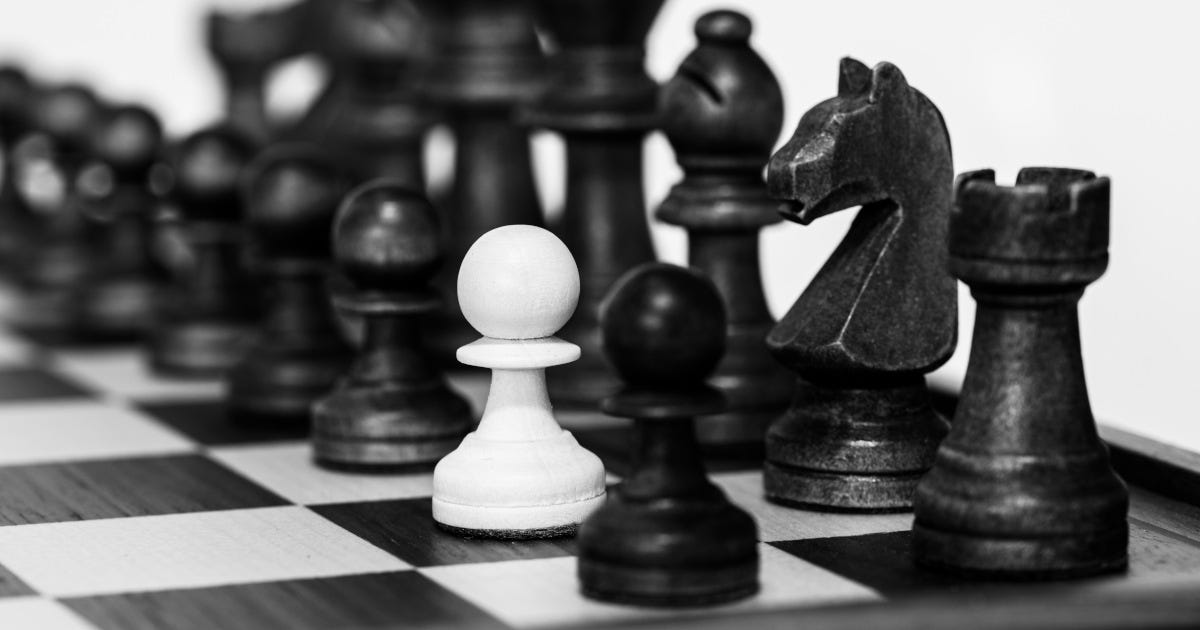
Sitting between the two was the finest chess set Cedric had ever beheld. Sixty-four squares in alternating light and dark tones were set into a polished wooden table. The chairs were a perfect complement, done in plush velvet; one in white, and one in black.
“The pieces are under here,” Elmer said, and lifted the table to reveal it had been bound together with a hinge on one side.
He removed a simple box, replaced the surface of the board, and aligned the container between them.
“White or black?”
Cedric thought for a moment, but his mind was sluggish and nothing came to mind. He apparently hesitated too long, because Elmer interjected.
“I’ll be white, you can be black.”
He opened the box and began to remove pieces, the remnants clacking together as gravity pulled them downward to fill the empty spaces left by their comrades.
“White always goes first. That seems like it should be an advantage, and maybe most of the time it is, but it doesn’t always work out that way. Every game is different.”
Cedric knew that the pawns all went in a line before the other pieces, so he arranged them carefully.
“Sometimes you just get caught in a loop thinking about what your opening should be, and you make a bad choice. You have to go in totally blind. You go second, well, then you already know something going in. That can help a lot, letting someone else set the stage.”
Elmer looked at what lay across from him. “The ones that look like castle turrets, those are the rooks and they go on the outside corners.”
Cedric found them and set them upright.
“The funny-shaped ones are the bishops, and they go next. S’posed to be a priest’s hat, I guess.”
Cedric aligned the next two pieces as he was told.
“Wait, no—”
Elmer looked down at his board.
“I’m stupid, that’s not right.” He reached across the board to Cedric’s side and shifted the pieces one space inward.
“The bishops are next to the king and queen; the knight goes next to them, sorry, I always mix that up.”
Cedric’s back row had three pieces to the left and three to the right. He looked at Elmer.
“Now for the big guys,” he handed the final two pieces in black to Cedric, who took them in his hands.
“Queen goes on her own color. Doesn’t matter which side you’re on, she’s always on her own color. King goes next to her. It’s her job to protect him.”
Cedric looked down at the pieces in his hand, and then back at Elmer.
“Which one is the queen?”
He indicated with his finger, a gesture seeming familiar, as if they’d always been friends.
“The king stands beneath the cross.”

“If—” Cedric stumbled, feeling sheepish. “If I am, really, what you say I am, then—”
He hesitated, looking at Myrtle, Davian, then blinking as if to wrest himself from their intensity. Myrtle was old, and lines shot out from the corners of her eyes like cobwebs. Davian, he’d begun to piece together, had accumulated far more years than his smooth face suggested.
“Will magic make you live forever?”
They looked at each other, and then back to him.
“Well, Cedric,” Davian said with resignation.
He looked down, hesitant, and then back up again. “I’m trying. That’s all you can ask.”

It wasn’t until nightfall that Myrtle found Cedric in his room. He had returned there at some point in the afternoon, slinking silently back up the stairs to avoid the children preparing cookies and tea.
He had sat on the bed for a while. The wall opposite was covered with shelves, each hosting a diverse population of tomes.
He then stood, the velvet curtain covering the window to his right. In his hand was, of all things, a candle; a candle he’d managed to light with the aid of a box of matches he’d found in the drawer of the bedside table.
Even here, before words he’d once believed part of his natural language, he could not escape what he had seen.
‘…Incantations…’
‘…Illusions…’
‘…Summoning…’
‘…Cantrips…’
He felt a little sick, and he collapsed, face-down on the bed.
Cedric may very well have fallen asleep, laying there quiet as the minutes crept by, until a knock, rather, three of them, announced the arrival of a visitor.
“Cedric, it’s Myrtle. May I come in?”
Her voice was muffled behind the barrier. He lifted his head to be heard.
“Yes, come in.”
The door seemed incomprehensible, and yet she moved it aside with little objection, the thing emitting little more than a faint squeak upon its hinges when she restored it to its mechanism.
She stood there for a moment, looking at the young man laying face-down, fully dressed, and yet, indelicate, exhausted, and completely weakened upon the dark red blanket.
She had raised a hundred orphans to maturity, and yet, she was at a loss for how to proceed.
“Would you—” she treaded carefully. “Like dinner?”
Cedric was empty.
“No,” he replied. “I’m not very hungry.”
“You haven’t eaten since breakfast,” she reminded him gently. “You should maintain your strength.”
He didn’t say anything for a moment, and then spoke as reflex. “I’ll eat when I’m hungry.”
They still had not looked at each other, avoiding the heat.
“May I speak with you?” She asked. “May I sit down?”
Cedric turned his head so that his voice was not so completely muffled by the thick cloth.
“Yes.”
But with the exception of his neck, he did not otherwise move.
“It is never easy,” she began. “To tell the initiates that they cannot trust in what they thought they knew.”
She continued, “To tell them that they should abandon all that came before.”
His neck began to ache, so he turned away from her.
“What Davian showed you last night,” she took a breath and considered her words. “It was sudden. It was a lot. Perhaps—”
She paused.
“Perhaps it was too much.”
Cedric did not want to say anything, but he said the first thing that rose to his mind.
“Was it real?”
She reflected. “It’s quite—”
“Real.”
Cedric, feeling sudden shame at his posture, lifted himself aloft and sat himself on the far side of the bed, far from the old woman in the black dress. He tried first to sit as she did, but, feeling naked, he drew his knees up to his chin and wrapped his arms around himself.
He looked at the bookshelf before him.
“Can—” he searched his mind. “Can anyone do it, if they try hard enough?”
Getting the word out required immense effort.
“…Magic?”
She didn’t look at him, but might have been looking at the same distant point on the bookshelf.
“Not everyone. Some easier than others, and maybe more could, if they were taught the right way.”
He listened.
“There’s no certainty. No set rules. In today’s world, more women than men, but maybe it didn’t used to be that way. Or maybe there were other factors at play.”
He closed his eyes and set his cheek against his forearm.
“I try to find the children young. Their minds are the most pliable, most able to accept what the world has forced them to bear. They are the smallest, their muscles soft and new, but they recover.”
She paused, and reframed her rhetoric.
“With the young, there is less that must be broken.”
Cedric did not move.
“I was grown before I met a fellow mage,” she related. “Nearly your age.”
He did not speak.
“I had worked magic for many years before that, but I did not have word for what I did. I did not understand what I had seen, and I excused it with the words I did have, few and bland as they were.”
He thought this was the time when she might have reached forward to touch him, and yet, she refrained.
“This world cannot contain you, Cedric. You have believed it your prison, and you have welcomed that reality, become comfortable in its routine, believing it something you, as an extension of Man’s Sin, deserve—”
“But paper,” she continued, quoting an idea he could not follow. “Cannot wrap fire.”