


When Cedric got out of bed on Wednesday morning, he had no foresight that he would never again return to this room. He had no idea how this day was destined to end.
He attached his wallet to his beltloop, slipped his knife into his right pocket, keys in his left, and, as the first anomaly, forgot to check himself in the mirror on the way out.
Book in one hand, he used the other to steady himself as he walked down the stairs. He reached the landing and performed a U-turn, bound for the kitchen.
Betty was frying eggs. She had a skilled hand at over-easy.
“Good morning, Cedric. You’re up early,” and, spying his clothing, she gave an addendum. “No work today?”
“I’m off today,” he stated. “Thought I’d do some exploring, see the area. Cross the river, maybe. I’ve never been to Beacon.”
“Can I fix you some breakfast — get some food in you?”
“No, thanks,” he felt some guilt refusing her, but his stomach had still not returned to normal. “I appreciate it, though.”
She nodded down to the book he carried. “What have you got there?”
He raised his hand so that she could look at the cover.
“It’s about some college kids in Vermont who get in over their heads. Librarian recommended it to me. But I’m having trouble getting into it. Read a few chapters, and it’s — I don’t know. Kinda overwrought.”
“I think I heard about that one,” she remarked. “It’s a mystery, right? I used to read a lot of mysteries.”
There was a pause between them, and then Betty spoke.
“You know, you could still go if you wanted to.”
“To Beacon?”
Betty smiled gently. “No, to school.”
Cedric laughed a little. “To… school?”
“You’re young. Why not?” She nudged the egg in the pan. “The ship has hardly set sail.”
“Too expensive. I can’t afford it.”
“I’m sure you could get a scholarship.”
“Or dig myself in a hole with interest.”
Betty frowned. “You’re too smart to work a cash register. You could be doing so much more. No one should have to toil doing things that are replaceable. You’re not a machine.”
Cedric did not say anything at first, and then held the book out to her.
“You want to read it?” he asked, and added, “It’s not really my thing. I want to finish what I was reading before.”
She took the book and looked at him in silence for a moment. When he made motion to leave, they waved farewell, and she realized with a twinge of despair that she’d overdone the toast.

Zed had come over to meet Cedric last night and give him a purple JanSport, inconspicuous — except for the pungent aroma of marijuana penetrating the fabric. Less than twenty-four hours since he’d returned from Eight Ball, Cedric had still been hungover. It had been unpleasant to stand for extended periods of time and he longed for recovery. But he had engaged in the necessary small-talk with his boss, accepted the package, and slipped the cash into his wallet. A minute later, Zed left Cedric holding the bag.
The thing stunk to high heaven and Zed had suggested he stow it in his trunk. Said it would be safer that way in case he ran into any trouble.
Cedric hoped against hope he wouldn’t have to worry about that.
But there was a problem with Zed’s idea. The trunk of the Cavalier had a faulty mechanism; sometimes it was nigh impossible to open the chamber without a fight. Now that the ambient temperature was decreasing with autumn’s onset, the metal was contracting and the issue more persistent. The very last thing Cedric wanted to happen was to have the delivery trapped inside the back of his car once he got to Manhattan. He had enough anxiety about transporting the contraband in the first place. He didn’t need to be seen hanging around on a busy street for fifteen minutes fumbling with the lock.
He had no choice. He ignored Zed’s advice, threw the bag to the foot of the passenger seat, and covered it with an old flannel.

The proposed route was simple enough. He would cross the bridge over the Hudson, drive a short distance to a town called Fishkill, and connect to Route 9 headed south. This highway would eventually turn into Broadway and go right into the city.
But nothing, certainly nothing, was going to be easy. Cedric re-entered I-84 for the first time in months and continued east, seemingly continuing where his journey had paused in June.
He had not gone far when he was again forced to stop.
Cedric peeled up against the tollbooth.
“$1.00.” The attendant, surly and wide-shouldered, projected loudly at the Cavalier, whose window was cracked several inches.
Cedric fully rolled down the glass.
“A dollar to cross a bridge?” He propped his elbow on the top of the car door.
The woman gestured to the sign.
“Yeah. A dollar. You read much?”
Cedric bristled at the question but nevertheless brought his wallet to his hand and removed a bill.
“Are you able to make change for a five?”
She took the money without comment and quickly returned to him what he was due.
She spoke with an emotionless, flat affect. “Four for you. Have a nice day.”
Cedric slipped the singles into his right pocket, depressed the pedal, and restarted the car.

The drive from Fishkill couldn’t have been more different than the drive east in June. The varying degrees of decaying foliage were beautiful, if somewhat wistful, but Cedric hardly noticed the changing season.
He was only minutes removed from the toll bridge over the Hudson, but he felt as if he’d entered another world. Shops and stores and parking lots divided the green and orange trees, nothing terribly striking on its own, but these places were quite different from Newburgh, he saw immediately.
They were clean. They were occupied.
His car, the beige long weathered by wind and rain, and now inexcusably rank with a perfume somewhat reminiscent of diesel — was decidedly unclean.
But he continued to drive.
The Sun was high in the sky at this hour, invoking a calm shadow inside the Cavalier. The roof blocked most of the blaring radiation that might have caused Cedric to squint painfully at another time of the day.
He still had no radio.
He had never wanted to pay to get it fixed in Newburgh. Over the several months he had lived there, he had found himself using the car only very seldom. He walked to the library, he walked to work, he walked back — he had fallen into a quiet life that aspired for little and accomplished even less.
But then, he didn’t want to be so hard on himself.
It was true that standing on the other side of the grocery checkout was not the glittering life he had envisioned before leaving middle America. It was indeed peaceful: he’d been reading again, Betty was a talented cook, and the persistent, aimless worry that had so often plagued him in his youth seemed to be slowly receding as he stopped feeding the pestilence.
He breathed.
Cedric had been forced to close the window when he’d entered the brisk pace of Route 9. The air inside the car was thick with the reminder of the task he hadn’t had the courage to refuse. He wanted the money.
‘Just this once.’
He glanced to verify the package still lay on the floor, in some kind of desperate hope against reality.
Of course it was still there, the violet material peeking out from beneath the grey cotton above; he hadn’t moved it, and the familiar odor choked the scant oxygen present in the sealed car.
His thoughts started to swirl chaotically as he plotted what to do when he completed the drop-off and returned to Newburgh.
He’d take the money from Zed and add it to the little profit he’d been making each week over the summer. With this windfall, he’d have just enough to start again somewhere else. He lamented leaving behind Betty, but he felt the alternative was worse.
The situation with Zed was becoming unbearable. What had begun as a manageable inconvenience had progressed into something much more dangerous.
The closer Zed had pulled Cedric into his web, the more Cedric had begun to pull away. He felt his skin crawl when the man sauntered past him, utter revulsion when he professed his desire to be “friends”, and Cedric realized he was choreographing his motions to avoid being alone with him —
Cedric was disgusted by Zed.
Perhaps some of it was the drugs; the more Cedric had seen of Zed behind the curtain, the more he had realized Zed was never in his right mind. He was always acting, always altered. But that fear of sobriety was not his primary sin, and Cedric, desiring self-consistency, could not ignore within himself the presence of a whispering curiosity at the periphery of the hedonism, something like Eve must have felt in her fatal attraction.
Zed didn’t give a damn about him. Some of what Cedric had initially taken as self-interest and arrogance he’d soon come to realize was the local character: the incessant chatter, the shifty mannerisms, and, his least favorite, a tendency to guillotine the sentences of others. He’d discovered that it was just part of the East Coast mindset to think everyone else spoke far too slowly and that they alone had a dire, inescapable need to insert their precious conclusions immediately into the discourse in order to relieve themselves of the intolerable boredom of listening to other people talk.
Though that all had exasperated Cedric, he had soon come to accept that with his change of locality came a change of flavor, and if he were to learn how to shed his chrysalis and become something new, he would have to adapt. This was what he had wanted. He had to accept the bitter truth that he was not already fully formed.
He considered Zed, feeling some clarity as he gained distance, and concluded that this was all part of the way Zed was fated to be as a consequence of what he had been taught. Though the content was changed from that to which he was accustomed, it was little different from how his own upbringing now formed his unconscious prejudice.
As Cedric continued to make his way south, slowly picking up speed, his conviction became ever more cemented in his mind. He’d done what he had set out to do: he had made his way east and had a little more money in his pocket. His new name felt comfortable when he heard it spoken aloud, where he had once felt an imposter hiding behind another man’s face. And with a few exceptions — a used Walkman, some t-shirts — he hadn’t acquired much new baggage to weigh him down. And that was the way he liked it.
The time had come to leave Newburgh behind.

As Cedric approached the city, the clean brick and spacious luxury gave way to the cluttered intensity of New York City. He had seen many depictions of this place, both modern and historical, long before he ever made his way down Broadway, but nothing had adequately prepared him for what he found.
The most immediate observation, the one from which he could not escape, was of the sheer multitude of human bodies that seemed to fill every square of useable space. They were everywhere: crawling the sidewalks, shading the windows, and even more of them had been created to fill billboards and advertisements.
When he stopped at a red light, the crowd clustering at the corner would pour across the intersection as a dense wave, and Cedric struggled to comprehend each of them as individuals. With so many of them together composing one motion, the details began to blend into a larger trend, and the once countable persons faded into a more easily understood mass. It was the face of the collective, and its expression was one of resolute disinterest.
In contrast to the bobbing oscillations of people, the buildings were still and maternal. The structures loomed high over man, guiding them, protecting them. They were the disguise of the city, if the humans were the heart and soul.
Cedric was bound for a small neighborhood called Sugar Hill. Zed had given him instructions to turn left onto an eastbound cross-street, with one further detail to guide his advance.
‘If you reach the park, you’ve gone too far.’
The larger apartment buildings that had flanked Broadway gave way to four-story brownstones, each set off from the sidewalk by a steep climb of stairs. The house numbers, odd to the left and even to the right, were difficult to read at a glance, but he oriented himself and continued, quickly crossing an avenue. Before he could have possibly absorbed all the details, he realized he had already arrived at his destination.
The narrow street was edged in on either side by a wall of parked cars. He slowed his progress down the street, looking to one side and then the other, trying to glean an opportunity between few simple options. He would have no other alternative than to back up and parallel park —
A car in an apparent rush suddenly appeared in the rear-view mirror. Cedric looked to one side only to jump in his seat as the car let out a blare of its horn, alerting him of his apparent transgression.
He pulled ahead and prepared to back up into the only space that was available. He was unaccustomed to executing the maneuver to the driver’s side, but it looked as if that was the only choice.
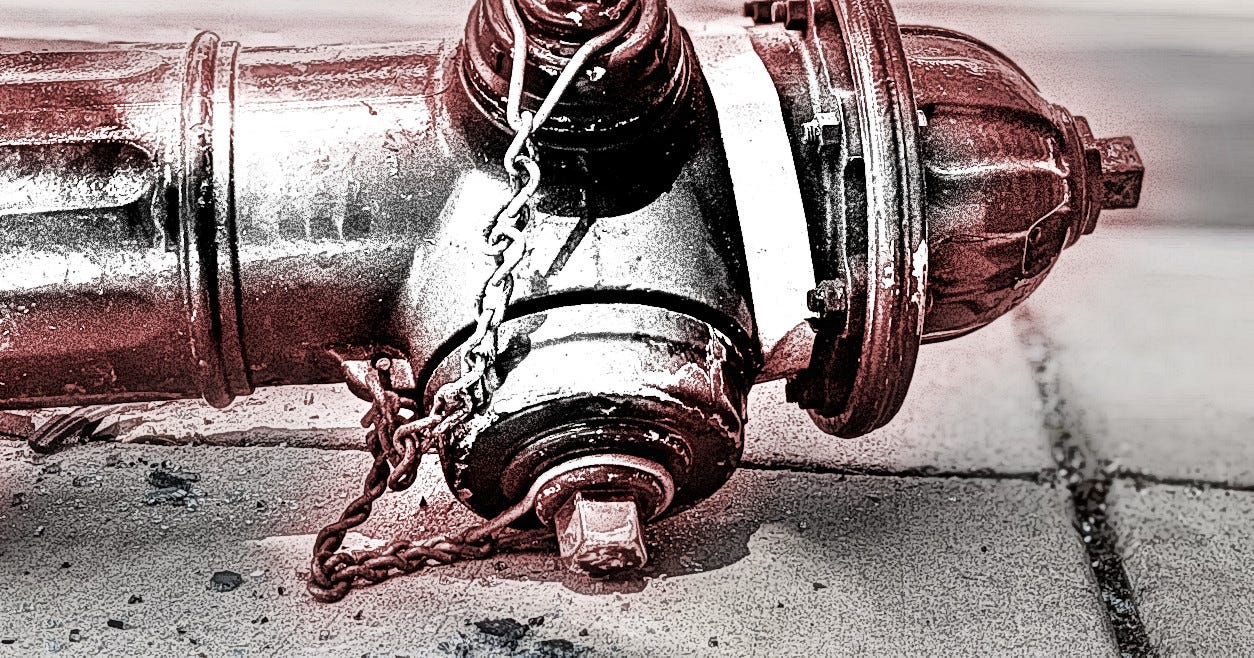
Cedric looked to the left and and panic washed over him — the only reason for the vacancy was a camouflaged fire hydrant. He hadn’t noticed it at the onset; it had been coated with paint that matched the muted tone of the pale brick buildings. He noticed a woman wearing a snug sweater-dress walking down the street doing something that stole his attention. She was talking to herself on a cordless phone.
The car behind him honked once more.
In his haste, he brought his attention back to the inside of the car and depressed the clutch. He pulled the gearshift out of first and pulled it toward reverse, except —
It refused him.
Cedric let loose with an obscenity lost to the ether as the car behind him simultaneously voiced its displeasure.
He tried in desperation to revoke his command and return to first gear, but the stick remained completely immobile, frozen between gears.
“Fuck!”
He tried again, but his efforts were completely futile. Behind him, the car let forth with several more honks of its horn, delivered in furious succession.
To add insult to injury, he was so close to the car on his left that he could not open the door.
As Cedric turned off the engine and restarted the car, he hoped something, anything, could alleviate the problem with the gearshift.
But it was no use. He heard a rapping on the window to his right while he continued to struggle.
“Hey, asshole!”
He could barely hear the man yelling at him through the closed windows, but that particular curse was clear as crystal.
Cedric looked up at the passenger window to see a man in a dark grey suit and navy tie craning down to peer inside the car.
“You gonna move your car?”
Cedric gestured to the stick shift. “It’s stalled! What do you expect me to do?”
The man screamed at Cedric through the glass, “Get a real car!” and returned to his vehicle.
Cedric looked down at his controls and tried a few more times to engage a gear, any gear, in an effort to move the car from its location blocking the lane of traffic. He heard tires squeal as the discontented suit successfully put his own car in reverse and backed out of the street.
He had to give up. Cedric turned off the engine, removed the keys, and awkwardly climbed over the center console of the car and made his way to exit the Cavalier on the passenger side, using his foot to push the backpack as far as he could get it from the incident light pouring through the window.
Outside the car was the woman who’d been walking down the street. She had pulled her phone away from her face and placed her opposite hand on top of the mouthpiece.
“Do you want me to call you a tow truck? You can’t fix it, can you?”
Cedric had never seen anyone using such a device in the flesh. He’d seen the brick phone on television, but it, with its bearer, had been as imaginary as a magical ring. And this phone was different: much smaller, and black.
He refused her offer as a reflex.
“No, maybe it just needs time to cool down. I’ll try again in a minute.”
Cedric looked away from her and felt the leaden weight of the contraband lingering in his car. He thought maybe he should just leave the car, take the bag up to the apartment, and deal with this issue once he’d made himself free of this burden. But the Cavalier made it impossible for anyone to drive down the street. He couldn’t leave it here.
The woman looked at Cedric and raised an eyebrow. “You sure you don’t want me to call you a cab?”
He had no chance to respond. He didn’t have to be a native to recognize the unmistakable wail of a police siren as it rounded the corner and made its way toward the helpless Cavalier.
Cedric felt hope drain from his body.
He stood still, completely stricken with terror, as the car drove toward him and stopped. Neither he nor the woman said a word as the doors opened and two members of the NYPD exited their vehicle and approached.
“Afternoon. You having some car trouble?”
Cedric felt sweat dampen his shirt as they walked up, one trailing the other.
“What seems to be the problem?” The officer’s voice was cordial, but Cedric could not help but feel as if he were staring down a lion and its pearly whites.
“I’m stuck between gears. Can’t move the car.”
The woman who’d approached him stepped away to establish her neutrality and he realized he’d been a fool.
The other officer took several long glances at the Cavalier, catching notice of the plates.
“You’re an awful long way from home. What brings you to the city?”
The two cops made eye contact while Cedric quickly searched his thoughts.
“Visiting a friend from college.”
The officers looked at him with skepticism.
“Oh yeah? What college?”
Cedric drew a complete blank, his hesitation tragically betraying his lie.
“I need to see your license and registration, son.”
‘Fuck, fuck, fuck.’
There was nowhere to go.
Cedric eyed the police officer, gleaning not a scrap of pity on that face: just doing his damn job. He slowly made his way to open the passenger side door.
‘Fuck, fuck, fuck.’
The cop took several more steps, coming up behind him as he opened the glovebox.
Cedric continued to sweat as he fumbled around with the papers that lay within.
He found what he needed, snapped the thing closed, and —
“I’m detecting the odor of marijuana coming from your vehicle.”
Cedric felt his heart rattle his chest.
Clutching the papers he’d taken from the glovebox, he turned around toward the man.
“My gas tank—”
“That’s not gasoline I’m smelling, sir. I’m going to need to search your vehicle.”
The other officer came over and approached the two of them. He stood over Cedric while the first leaned into the car, tossed the shirt aside, and removed the JanSport.
Cedric averted his eyes as the evidence was exposed to the light.
“Sir, I’m going to need you to place your hands on the vehicle.”
What little pretense of resistance had been in Cedric completely evacuated his body. He kept his gaze down.
He surrendered.
The officer ran his hands over him, emptied his pockets, and confiscated his belongings. When Cedric felt the cold metal snap around his wrists, he knew he had lost.
He did not look up until he was sitting in the backseat of the police cruiser. Outside the window, he saw the woman fold her phone and push the antenna back into its housing.
He watched her until the car turned the corner and veered out of sight.